
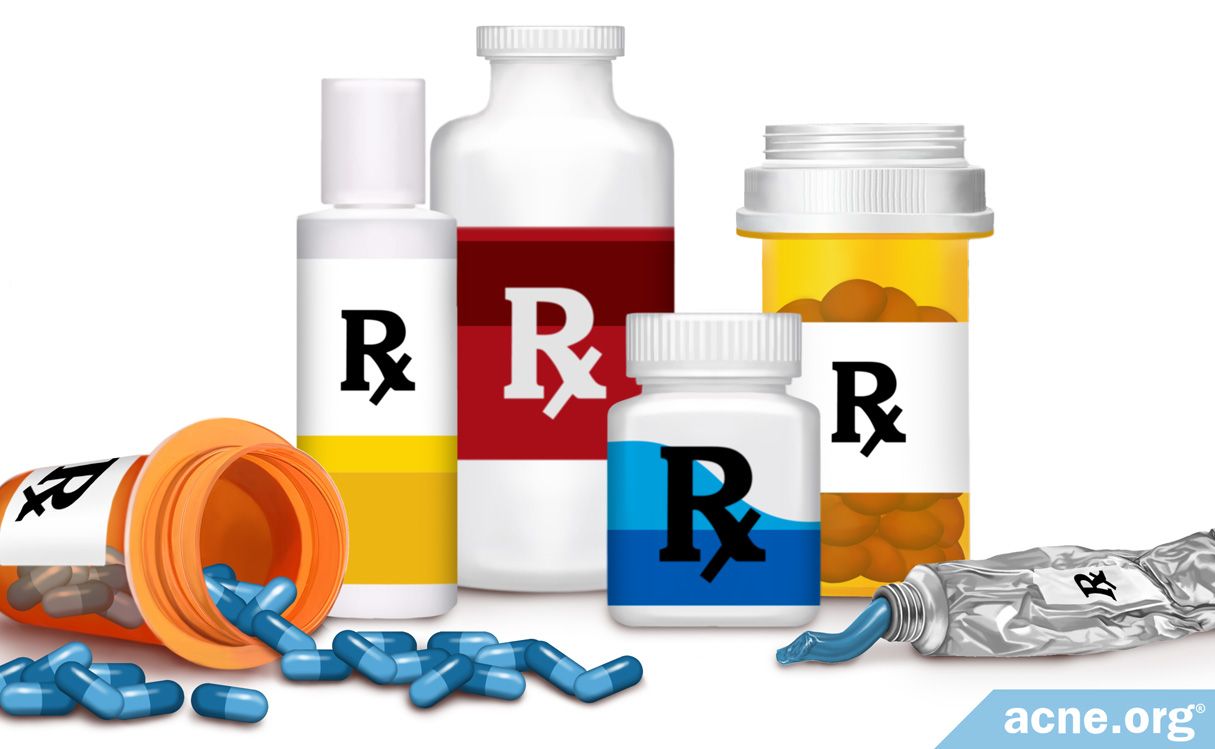
If you have moderate to severe acne, or have mild acne for which over-the-counter medication has proved ineffective, then we provide a brief guide to prescription acne treatments.
If you are suffering from moderate to severe acne then fortunately there are a large number of prescription medications available to treat the problem. Some of these medicines are applied directly to the skin (topical medications), while other are taken in pill form or can be given by injection.One of the oldest and most effective prescription medications used for treating moderate to severe acne is Accutane, which contains the drug isotretinoin. Today it is used by million of people to treat advanced forms of acne, including cystic acne.Accutane is a powerful medication and is issued under prescription because it does have a number of side effects and risks associated with its use. In particular, studies have shown that isotretinoin can cause birth defects and, accordingly, it is not recommended for use by pregnant women.Isotretinoin is a retinoid similar to Vitamin A and is taken in pill form once or twice a day normally for a period of about four to five months.Oral antibiotics are another common prescription treatment for acne because the condition is caused, at least in part, by a bacterium known as Propionibacterium acnes.One of the most commonly used oral antibiotics is tetracycline (or a derivative form such as minocycline or doxycycline) which has been in use for many years and can be especially effective in treating inflammatory acne. Treatment normally starts at a dosage of five to ten grams a day and this is reduced as the treatment proceeds. In some people tetracycline can make the skin sensitive to sunlight.Another common antibiotic treatment is the broad spectrum antibiotic erythromycin. It works in much the same way as tetracycline but has a tendency to cause gastrointestinal problems in some people.When it comes to topical treatments, antibiotic creams can again be used to attack the acne bacteria through the surface of the skin and are normally used in the treatment of moderate, but not severe acne. Indeed, they are also often used for mild acne where over-the-counter treatments have proved ineffective.There are also a number of retinoid creams and gels which essentially contain the same compound as over-the-counter medications, although in higher strengths which warrant their issue under prescription. Adapalene and Tretinoin are two commonly prescribed retinoid creams.If you have tried over-the-counter medications for your acne and have not found that they have given you satisfactory results then it is well worth talking to your doctor or a dermatologist. In the first instance he will be able to give you a clear diagnosis for the particular type of acne from which you are suffering and recommend a course of treatment.Nowadays , there are very few cases of acne for which an effective treatment is not available.


Do You Need to Get a Cystic Acne Treatment Quick?
Cystic acne is very difficult to get rid of.� Not only does it enlarge and reshape your pores, it burrows deep into your skin, making it painful and very hard for regular cleansers to reach and kill.� I've suffered from cystic acne, and I'm here to tell you, there's certain cystic acne treatments that work, and certain ones that don't.� Here's some of the best cystic acne treatment options that I've used and have found to be very successful when getting rid of this painful condition.
Read More
Three Acne Treatment Reviews to Get Rid of Your Acne Right Away and Forever
Many acne treatment reviews will make you think you need to purchase hundreds of dollars worth of acne products to successfully heal your face and skin of acne.� While these expensive products might work for some people, I've found that it's the lesser priced products that work just as well, if not better.
Read More
Treating Acne With Prescription Medication
If you have moderate to severe acne, or have mild acne for which over-the-counter medication has proved ineffective, then we provide a brief guide to prescription acne treatments.
Read More
Tips For Halting Acne
The myths and fairy tales surrounding acne didn't help either. My family members firmly believed that acne was a result of poor (or more specifically, junk) diet. Yes, I will admit that I, like any other team, enjoy my fair share of junk food, but I wasn�t too sure that eating out was the cause of my acne.
Read More
This Article was written by : Donald Saunders, Discuss about Health Articles, it was published at June 8, 2008 and was updated at
Comments
Post a Comment